Blog
High-Speed Drilling Tools in Delhi | Premium Quality Tools
Quick Answer
High-Speed Drilling Tools in Delhi are drill bits, cutters, and related accessories built to cut cleanly at higher rotational speeds without losing their edge or overheating. They’re used across metal fabrication, woodworking, construction, marble and tile work, fitting shops, and maintenance teams. When buying, the four things that actually matter are material compatibility (what you’re drilling into), bit diameter and shank type, the speed and torque your machine delivers, and the grade of steel or carbide used in the tool. Getting these right matters more than brand loyalty, a correctly matched ₹200 bit will outperform a mismatched premium one every time. In Delhi, buyers can source drill bits, cutting wheels, blades, and workshop accessories from suppliers like Oddessey Power Tools in Hauz Qazi.
What Are High-Speed Drilling Tools?
The term covers two related things, and it helps to separate them.
First, there’s the tool steel itself. High-Speed Steel (HSS) is an alloy steel containing elements like tungsten, molybdenum, chromium, and vanadium. What makes it “high-speed” is its red hardness — the ability to keep its cutting edge even when friction heats the tip to several hundred degrees. Ordinary carbon steel bits soften and go blunt at those temperatures. HSS doesn’t.
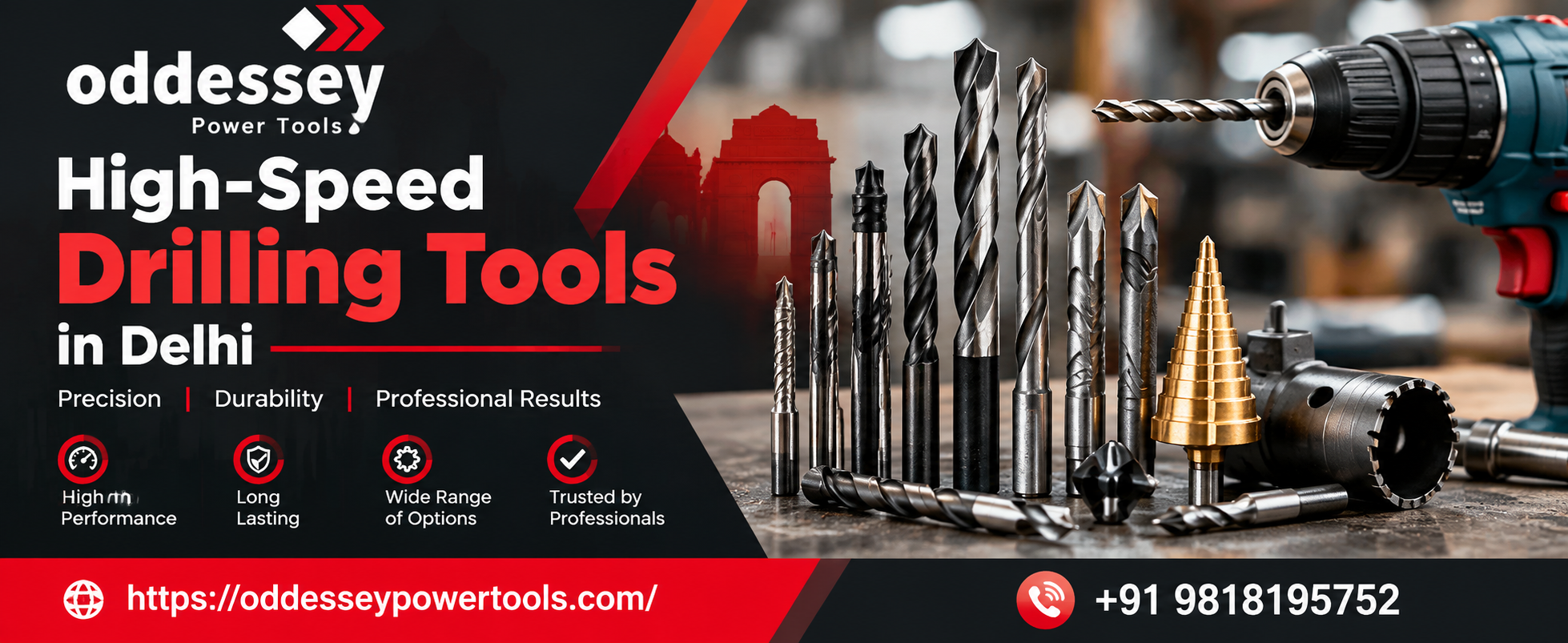
Second, there’s the category of drilling equipment built to run at higher RPMs: twist drills, step drills, hole saws, core bits, masonry bits with carbide tips, and the chucks and adapters that hold them.
Common variants you’ll come across in the Delhi market:
- HSS (M2 grade) — the general-purpose workhorse for mild steel, aluminium, brass, and wood
- HSS-Co (cobalt alloy) — better heat resistance, used on stainless steel and tougher alloys
- TiN-coated HSS — a titanium nitride surface coating that reduces friction and extends tool life
- Carbide-tipped masonry bits — for concrete, brick, and stone with a hammer drill
- Diamond-segmented blades and core bits — for marble, granite, and tile
Understanding which of these you need is the single biggest factor in whether a drilling job goes smoothly or ends with a snapped bit.
Why Choose High-Speed Drilling Tools in Delhi?
Delhi’s tool trade is concentrated and competitive, which works in a buyer’s favour. Areas like Hauz Qazi, Chandni Chowk, and Chawri Bazar have supplied hardware and industrial tools for decades, and that density means three practical advantages:
Physical inspection before purchase. You can check flute geometry, shank finish, and point angle in person rather than relying on a product photo.
Range availability. Fabrication shops, furniture units, interior contractors, and stone-cutting workshops all operate in and around the NCR, so suppliers stock across categories rather than specialising narrowly.
Faster replacement cycles. Consumables like drill bits and cutting wheels wear out. A local supplier means a same-day replacement instead of a week’s downtime.
For contractors and workshop owners running jobs on deadline, that last point is often decisive. Searching for high-speed drilling tools in Delhi usually comes down to finding a supplier who stocks consistently and can answer a technical question over the phone.
Applications of High-Speed Drilling Tools
| Application | Typical Material | Suitable Tool Type |
| Metal fabrication & welding shops | Mild steel, MS plate | HSS twist drills (M2), step drills |
| Stainless steel work | SS 304 / 316 | Cobalt HSS (HSS-Co), reduced speed |
| Woodworking & furniture | Plywood, MDF, hardwood | Brad point bits, auger bits, hole saws |
| Electrical & plumbing installation | Brick, RCC wall | Carbide-tipped masonry bits (SDS / round shank) |
| Marble, granite & tile work | Stone, vitrified tile | Diamond core bits, marble cutting blades |
| Sheet metal & ducting | GI sheet, aluminium | Step drills (cone bits) |
| Maintenance & assembly | Mixed materials | Multi-purpose bit sets |
In practice, most workshops keep a core set of HSS twist drills in common sizes, plus specialised bits for whatever their primary material is.
How to Choose the Right Drilling Tool
Work through these in order. It takes two minutes and prevents most bit failures.
1. Identify the material first
This determines everything downstream. Drilling stainless with a standard HSS bit at full speed will burn the tip within seconds. Drilling wood with a masonry bit gives you a ragged, oversized hole.
2. Match speed to diameter and material
The general rule: harder material and larger diameter both mean lower RPM. A 3 mm bit in aluminium can run fast; a 16 mm bit in stainless needs to run slow with steady pressure and cutting fluid.
| Material | Relative Speed | Notes |
| Aluminium, brass | High | Clears chips easily; watch for grabbing |
| Mild steel | Medium | Use cutting oil on thicker sections |
| Stainless steel | Low | Cobalt bit, firm constant pressure, coolant essential |
| Hardwood | Medium–High | Back off to avoid burn marks |
| Concrete / brick | Medium, hammer mode | Carbide tip, let the hammer action do the work |
| Tile / marble | Low, no hammer | Diamond bit with water cooling |
3. Check shank compatibility
A 13 mm keyless chuck won’t accept a 16 mm straight shank. SDS-Plus bits won’t fit a standard drill. Reduced-shank bits solve larger-diameter drilling on smaller chucks — worth knowing before you buy.
4. Consider your actual workload
Occasional home use and eight-hour production drilling are different problems. Continuous-duty work justifies cobalt or coated bits; intermittent use rarely does.
5. Buy the right sizes, not the biggest set
Most shops use 6 mm, 8 mm, 10 mm, and 12 mm repeatedly and rarely touch half the sizes in a 19-piece set. Buying frequently used sizes individually, in better quality, is usually the smarter spend.
Key Features to Consider Before Buying
Point angle. 118° is standard for general-purpose drilling. 135° split-point bits self-centre better on metal and need less punch-marking.
Flute design. Deeper, well-polished flutes evacuate chips better, which keeps heat down. Poor chip clearance is a common cause of bits seizing in deep holes.
Concentricity. A bit that wobbles produces oversized, off-centre holes. Roll the bit on a flat surface — visible run-out is a red flag.
Coating. TiN (gold), TiAlN (dark), and black oxide all reduce friction differently. Coating helps, but it doesn’t turn a low-grade bit into a good one.
Shank finish. Machined, clean shanks grip properly in the chuck. Rough or burred shanks slip under load.
Hardness consistency. Properly heat-treated HSS holds an edge through repeated sharpening. Under-treated bits go dull after a handful of holes.
High-Speed Drilling Tools for Professionals and Workshops
Professional users judge tools differently from occasional users. The question isn’t “does it drill a hole” — it’s cost per hole over the tool’s life, plus the downtime cost when something fails mid-job.
For a fabrication shop, a bit that lasts three times longer at double the price is straightforwardly cheaper. For a contractor drilling anchor holes across a site, carbide tip quality and shank durability determine how many bits get consumed per floor.
Practical habits that extend tool life:
- Use cutting fluid on metal. Even ordinary cutting oil dramatically reduces tip wear.
- Pilot-drill large holes. A 4 mm pilot before a 14 mm bit reduces load and improves accuracy.
- Let the tool cut. Excessive pressure generates heat and work-hardens stainless, making it harder to drill.
- Peck-drill deep holes. Withdraw periodically to clear chips.
- Re-sharpen HSS bits. Quality HSS can be reground several times before replacement.
- Store bits in an index, not loose in a box. Cutting edges chip against each other.
Why Quality Matters in Drilling Applications
Poor-quality drilling tools fail in ways that cost more than the tool. A bit that snaps inside a workpiece may ruin the component. An off-centre hole in a fabricated assembly means rework. A masonry bit whose carbide tip detaches mid-hole is a genuine safety concern.
Precision matters too. In fitting and assembly work, hole tolerance affects whether fasteners seat correctly. Bits with poor concentricity produce holes that are slightly oversized and slightly angled — tolerable once, problematic across a hundred holes.
Safety practice should accompany tool quality: eye protection, secure workpiece clamping, no loose sleeves or gloves near rotating bits, and correct chuck tightening every time.
Buying High-Speed Drilling Tools from a Reliable Supplier
A good supplier does more than hold stock. Look for:
- Range across categories — drill bits, cutting wheels, blades, abrasives, and accessories from one source simplifies procurement
- Consistent availability of your repeat-use sizes
- Willingness to advise on material and application
- Spare parts and accessories for the tools you already own
- Clear contact and support channels
Oddessey Power Tools, based at Modern Impex, 3268, 1st Floor, Gali Raja Wali, Peepal Mahadev, Hauz Qazi, Delhi-110006, stocks drill bits alongside wood cutting blades, cutting wheels, marble cutting blades, abrasives, hand tools, measuring tapes, spare parts, and power tool accessories. For contractors and workshops sourcing across several categories, that breadth reduces the number of vendors to manage.
Explore the drill bit and accessories range, or call 9818195752 for product details and purchasing assistance.
Frequently Asked Questions
What are high-speed drilling tools used for?
They’re used for drilling metal, wood, masonry, stone, and composites across fabrication, construction, carpentry, electrical and plumbing installation, tile and marble work, and equipment maintenance.
What’s the difference between HSS and cobalt drill bits?
Cobalt bits (HSS-Co) contain added cobalt, which improves heat resistance and hardness. They handle stainless steel and hard alloys better, but cost more and are slightly more brittle. Standard HSS is sufficient for mild steel, aluminium, brass, and wood.
How do I choose the right drill bit size?
For clearance holes, match the bit to the fastener’s outer diameter. For tapped holes, use the tap drill size specified for that thread. For wall plugs, use the size printed on the plug.
Why do my drill bits keep breaking?
Usually one of four causes: wrong bit type for the material, too much feed pressure, speed too high for the diameter, or poor chip evacuation in deep holes. Snapping at the shank often indicates a chuck that wasn’t properly tightened.
Can I use a masonry bit on metal or wood?
It’s not advisable. Carbide masonry tips are ground for a chipping action on brittle material, not clean cutting. You’ll get rough, oversized holes and premature tip wear.
Where can I buy high-speed drilling tools in Delhi?
Delhi’s hardware and industrial tool market is concentrated around Hauz Qazi, Chandni Chowk, and Chawri Bazar. Oddessey Power Tools operates from Hauz Qazi and supplies drill bits, blades, cutting wheels, abrasives, and workshop accessories.
Should I buy a set or individual bits?
Sets suit general-purpose and occasional use. Professionals who repeatedly use a few sizes usually get better value buying those sizes individually in higher grades.
Conclusion
Choosing high-speed drilling tools well is mostly about matching the tool to the material, running it at an appropriate speed, and buying a grade suited to your workload. Those three decisions determine tool life and hole quality far more than price alone.
For buyers comparing high-speed drilling tools in Delhi, the practical advantage of local sourcing is inspection before purchase and quick replacement of consumables. If you’re setting up a workshop, restocking a site, or unsure which bit suits a specific material, reach out to Oddessey Power Toolsfor guidance on the right drilling tools and accessories for your work.
Contact us :- https://oddesseypowertools.com/contact-us/