Blog
Holesaw Set Supplier: How to Choose the Right Hole Saw Kit for Every Job
Why Choosing the Right Holesaw Set Supplier Matters
A neat circular opening can be the difference between a professional installation and a costly rework. Electricians need openings for conduits and fittings. Carpenters cut passages for hardware and pipes. Plumbing, maintenance and fabrication teams need repeatable holes that fit the component rather than leaving oversized or ragged edges. For many of these jobs, a hole saw fitted to a compatible drill is more practical than repeatedly drilling around a marked circle.
Yet a holesaw kit should not be chosen by piece count or price alone. Two sets that look similar may differ in the diameter selection, tooth design, intended cutting materials, arbor arrangement and replacement-part availability. A good Holesaw Set Supplier helps buyers understand these differences before they commit to a tool that may not match their work.
This guide explains what a hole saw set includes, how to select the right option for different applications, the questions to ask a supplier and the safe working practices that help extend tool life. It also looks at the available Oddessey Holesaw Set variants so buyers know what to confirm before ordering.
Quick Answer: What Should You Look for in a Holesaw Set Supplier?
A reliable Holesaw Set Supplier should offer kits with clearly identified sizes, stated material compatibility, suitable arbor and pilot-drill arrangements, consistent product information and dependable assistance with availability and replacement accessories. Choose a set based on the hole diameters and materials you cut most often—not simply on the largest number of pieces in the box. Check the tool manufacturer’s speed and safety guidance before use.
What Is a Hole Saw Set and How Does It Work?
A hole saw is a circular cutting attachment with cutting teeth around its rim. Mounted to an appropriate drill through an arbor, it cuts an annular path through a workpiece rather than removing the entire circular area as chips. The remaining circular core, sometimes called a plug, must be removed safely after the cut. A pilot drill, where supplied, helps centre the saw and establish the starting position.
The term hole saw set refers to a collection of components for making circular holes of different diameters. Depending on the kit design, this can include several saw cups, one or more arbors, pilot bits and accessories. Piece count does not always equal the number of usable hole sizes because fittings and accessories can be included in the count.
A typical process is simple, but good setup matters:
- Mark the centre. Confirm the hole diameter and location, and check for hidden wiring, plumbing or other hazards.
- Select the saw. Choose a diameter appropriate for the component and verify the cutter is rated for the workpiece material.
- Inspect the assembly. Secure the saw and arbor, check the pilot drill and inspect the teeth for wear or damage.
- Support the material. Clamp smaller workpieces, protect the backing surface and provide space for the cutter to break through.
- Cut with control. Use the recommended drill speed and an appropriate feed pressure, keeping the tool square to the surface.
- Finish safely. Allow the tool to stop, isolate the power and remove the cut plug with suitable tools instead of fingers near sharp teeth.
A holesaw is not a universal cutter. A blade meant for timber may be unsuitable for hardened steel, tile or masonry. The relevant product specification, not the appearance of its teeth, should determine where it can be used.
Components to Compare in a Holesaw Set
| Component or feature | What to check | Why it matters |
|---|---|---|
| Hole saw diameter | Exact millimetre sizes included | Determines which fixtures and fittings can be accommodated |
| Cutting teeth | Tooth form, material and stated application | Affects cutting efficiency and suitability for the workpiece |
| Arbor or mandrel | Fit with the cutter and drill chuck | Prevents compatibility surprises at the job site |
| Pilot drill | Type, positioning and replacement options | Helps centre and start the cut accurately |
| Cutting depth | Usable cutting depth listed by the maker | Indicates whether the tool can pass through the intended thickness |
| Set configuration | Cups, adapters and accessories actually included | Makes kits with different piece counts comparable |
| Spare parts | Availability of arbors and pilot bits | Can reduce the cost of maintaining a frequently used kit |
| Storage | Case layout and identification markings | Makes transport and size selection easier |
Diameter Selection and Fit
Start by listing the diameters required for current work rather than buying every size available. An electrician installing cable entries, for example, may need a different range from a carpenter cutting openings for a pipe or door hardware. Measure the fitting and consider required clearance, installation tolerances and the manufacturer’s specification. Nominal pipe size is not always the same as the outside diameter of the hole needed.
Cutter Material and Tooth Design
General-purpose steel, bi-metal and carbide-tipped hole saws are used for different cutting conditions, but their suitability depends on the specific product. Some designs are intended mainly for wood or plastic; others are developed for certain metals or abrasive materials. Do not assume that all sets include bi-metal or carbide cutters. Ask for the cutter construction and permitted materials for the exact SKU.
Arbor Compatibility and Replacement Parts
A cutter is only convenient when it fits the drill and can be mounted securely. Check the chuck capacity, arbor style, pilot bit and whether additional adapters are needed for particular diameters. For a maintenance team, the cost of a replacement pilot drill or arbor can matter as much as the initial set price.
Applications of Hole Saw Sets Across Trades
A useful kit allows tradespeople to make circular openings without changing to specialised workshop machinery for every small job. Application suitability always depends on the cutter’s rating and the substrate.
| Trade or setting | Typical application | Important consideration |
|---|---|---|
| Electrical installation | Openings for cable pathways and fittings | Verify the hole diameter and isolate hidden electrical services |
| Plumbing and maintenance | Pipe penetrations in compatible panels | Allow correct clearance around the pipe or sleeve |
| Carpentry and interiors | Circular cut-outs in timber boards | Support the reverse side to reduce tear-out |
| Furniture assembly | Openings for cable grommets and fittings | Use an appropriate cutting depth and backer board |
| Workshop fabrication | Repeated holes in approved sheet materials | Confirm cutter grade, speed and lubrication guidance |
| Facility maintenance | Occasional repairs across multiple areas | Prioritise a sensible range of sizes and easy-to-replace components |
For Electricians
When preparing a panel or non-energised enclosure, the aim is a clean opening with minimal damage around its edge. Verify that the cutter is rated for the panel material, deburr the finished hole and protect cables with the correct grommets or glands. Before cutting, confirm that the enclosure is isolated and that the opening will not weaken or compromise its required protection rating.
For Carpenters and Installers
Hole saws can create openings for cable access, pipe routes and other circular fittings in compatible wood-based materials. A sacrificial backer board can help support the material as the tool exits. For veneered or laminated surfaces, use the appropriate cutter and technique to minimise chipping; trial cuts on scrap are valuable when finish quality matters.
For Maintenance Teams
A compact multi-size set can save time when work moves between sites. However, an infrequently used large assortment can be less useful than a smaller kit with the most common diameters and dependable replacements. For repeated industrial cutting, evaluate whether a job-specific cutter would offer better performance.
How to Choose Between 6-, 8-, 11-, 12- and 16-Piece Sets
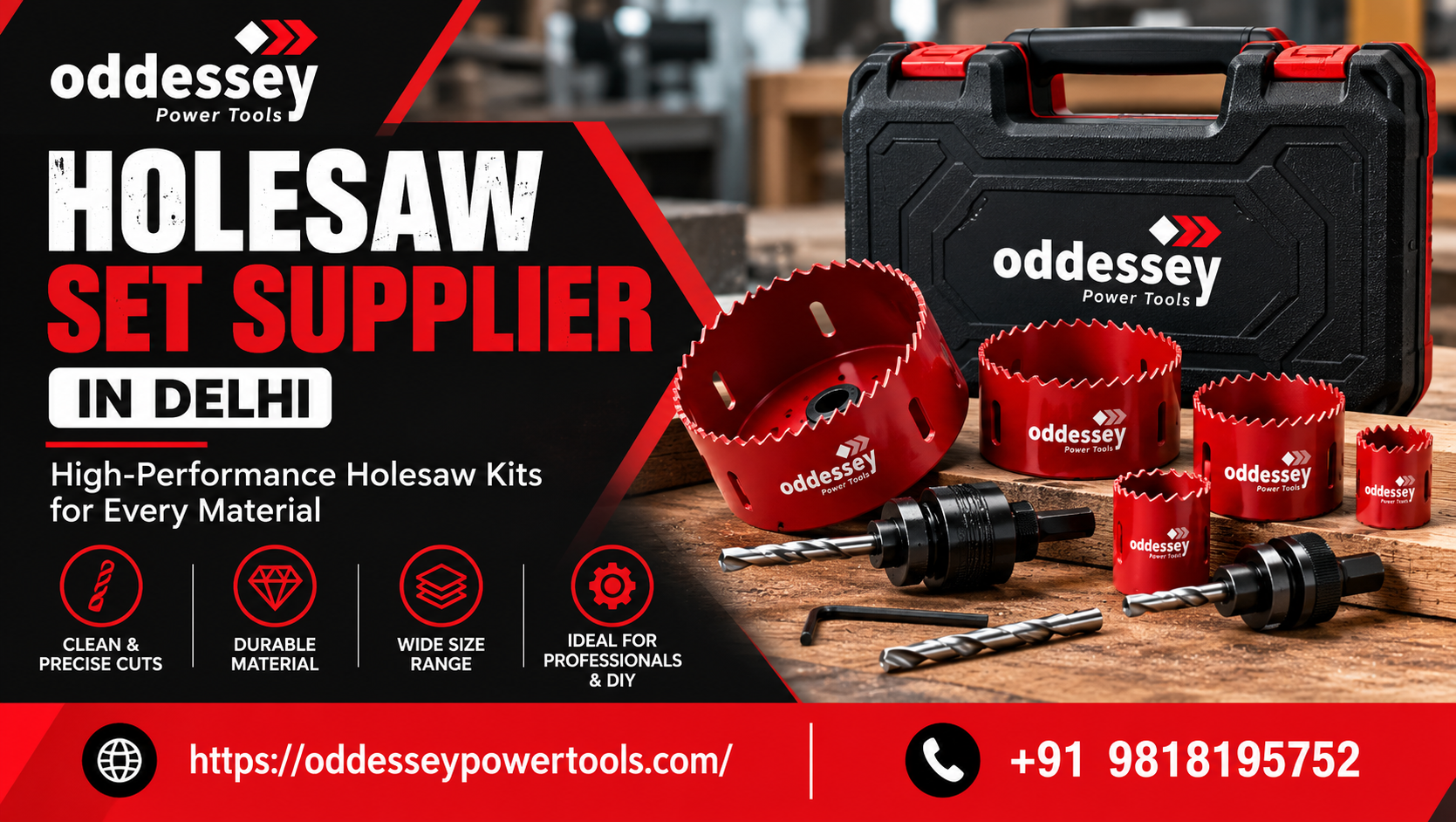
Oddessey Power Tools currently lists its Oddessey Holesaw Set in 6-piece, 8-piece, 11-piece, 12-piece and 16-piece variations. The listing establishes available pack configurations; it does not clearly establish every diameter, included accessory or cutter material for each variation. Buyers should request or check the set contents before comparing options.
| Listed Oddessey variation | A practical buyer question | Best way to evaluate it |
|---|---|---|
| 6-piece set | Does this cover my few regular hole diameters? | Request the exact included sizes and arbor details |
| 8-piece set | Does it add sizes I will genuinely use? | Compare the full contents with the smaller kit |
| 11-piece set | Are the extra pieces cutters or accessories? | Confirm usable saw diameters, pilot bits and fittings |
| 12-piece set | Does it fit my mixed installation work? | Check material ratings and attachment compatibility |
| 16-piece set | Is the broader assortment worthwhile? | Compare frequency of use, storage, contents and spares |
Important: The set variation names are not proof of any particular diameter range, cutting depth or ability to cut metal, concrete or tile. Those details should be verified against current product specifications or the supplier’s confirmation.
Questions to Ask a Holesaw Set Supplier Before Ordering
When purchasing for regular workshop use or multiple technicians, a short specification checklist prevents mistakes more effectively than a generic product description.
- Which exact diameters are in the box? Request a piece-by-piece list, preferably in millimetres.
- What materials can each cutter handle? Ask about wood, plastic, thin sheet metal or other materials relevant to your work.
- Which drill and arbor are required? Confirm chuck fit, mounting arrangement and the availability of adapters.
- What is the allowable cutting depth? A cutter may be wide enough but not deep enough for the planned workpiece.
- What speed or lubrication guidance applies? Incorrect speed, pressure or cooling may overheat the teeth.
- Can worn components be replaced? Pilot bits and arbors can be common wear or loss items.
- What are the current stock and order terms? Confirm quantities, dispatch details and any bulk purchase terms before planning a project.
For procurement teams, a sample inspection or trial cut may be worthwhile before issuing a large repeat order. Record the outcome by material type and size so subsequent purchases are based on performance rather than packaging.
Using a Hole Saw Safely and Getting Cleaner Results
Hole saws cut a relatively wide circumference, so they can generate substantial torque and may bind if the tool is forced, misaligned or not suited to the material. The operator should follow the tool and drill manufacturers’ instructions, use the appropriate guarding and personal protective equipment, and secure the workpiece.
Keep the work steady. Clamp small components rather than trying to hold them by hand. Use a stable stance and the appropriate drill handle when needed. A spinning workpiece or sudden catch can cause serious injury.
Avoid forcing the cut. Feed pressure should let the teeth work. Excessive pressure may cause overheating, rough cuts, tooth damage or tool kickback. Periodically clear chips using a safe method after stopping the machine, especially on deep cuts.
Check both sides before drilling. Look for hidden cables, pipes and people behind the work surface. In finished interiors, confirm that the hole position does not interfere with a structural, electrical or plumbing element.
Inspect worn parts. Missing teeth, damaged arbors or bent pilot drills can affect accuracy and safety. Damaged accessories should be replaced rather than improvised with makeshift fixes.
Use the right cutter for the material. A product sold as a generic holesaw set should not be treated as automatically rated for stainless steel, stone, tile or concrete. Those jobs may require dedicated cutters and procedures.
Common Holesaw Buying and Usage Mistakes
| Mistake | What can go wrong | Better approach |
|---|---|---|
| Choosing solely by piece count | The kit misses essential diameters | Compare a written contents list |
| Assuming universal material compatibility | Rapid wear or cutter failure | Check the rating for the actual surface |
| Ignoring arbor fit | The cutter cannot attach to the drill | Check chuck, arbor and adapters in advance |
| Using too much speed or force | Heat, binding and rough edges | Follow recommended speed and feed guidance |
| Cutting unsupported panels | Vibration or tear-out | Clamp and back the work securely |
| Neglecting replacement parts | A small lost part disables the kit | Ask about spare pilot drills and arbors |
| Forgetting hole clearance | Fittings do not seat correctly | Confirm finished opening diameter requirements |
Why Explore Oddessey Power Tools for Holesaw Sets?
Oddessey Power Tools offers hole saw sets through its online cutting-accessories range. Its product listing displays multiple set-size variations, allowing buyers to begin a comparison based on how many components they need. The company also lists related workshop accessories, which may be useful when sourcing several tool categories together.
The sensible buying process is to begin at the Oddessey Holesaw Set product page, choose the variation of interest and verify the exact saw sizes, included fittings and material suitability before placing an order. For trade or bulk quantities, ask the supplier to confirm availability and provide any additional technical details missing from the listing.
Supplier selection is about matching the actual tool to the job. Clear specifications, dependable availability and replacement support matter more than a broad promise that one kit works everywhere.
Frequently Asked Questions
What does a holesaw set supplier provide?
A holesaw set supplier provides multi-component cutting kits and, depending on the business, associated drilling accessories. A good supplier should be able to explain the exact set contents, suitable materials, drill compatibility and ordering options.
Can a holesaw set cut wood, PVC and metal?
Some hole saw designs can cut particular grades of wood, plastic and metal, but not every kit can cut all three. Product-specific tooth material, speed limits and workpiece thickness are critical. Confirm the stated application of the exact cutter before use.
Is a 16-piece holesaw set automatically better than a 6-piece set?
No. A larger kit may contain useful extra sizes or components, but the smaller one can be more efficient if it already covers your routine work. Compare usable diameters, quality, compatibility and the cost of parts you are likely to replace.
What is the difference between a hole saw and a regular drill bit?
A standard twist drill removes material across its cutting diameter, while a hole saw generally cuts a circular ring and leaves a central plug. Hole saws are useful for larger circular openings, subject to material and tool limitations.
How do I prevent a hole saw from overheating?
Use a cutter rated for the material, the recommended speed and feed pressure, adequate support and any cooling or lubrication specified by the manufacturer. Stop if the cutter binds, overheats or becomes damaged.
Does Oddessey offer different holesaw kit sizes?
Yes. Its product page lists 6-, 8-, 11-, 12- and 16-piece variants. Confirm the latest selection and the components included in each kit directly on the product page or with the supplier.
Conclusion: Buy a Holesaw Set for the Work You Actually Do
A dependable Holesaw Set Supplier should make it easier to select appropriate diameters and compatible cutting accessories, not just offer an assortment of boxes. Begin with your most common applications, verify cutter material and mounting details, and consider spare-part availability and safe operating requirements. A correctly chosen kit can support cleaner openings and more consistent results across electrical, carpentry, plumbing and maintenance work.
Explore the Oddessey Holesaw Set and confirm the set configuration that matches your tool, material and hole-size requirements before ordering.