Blog
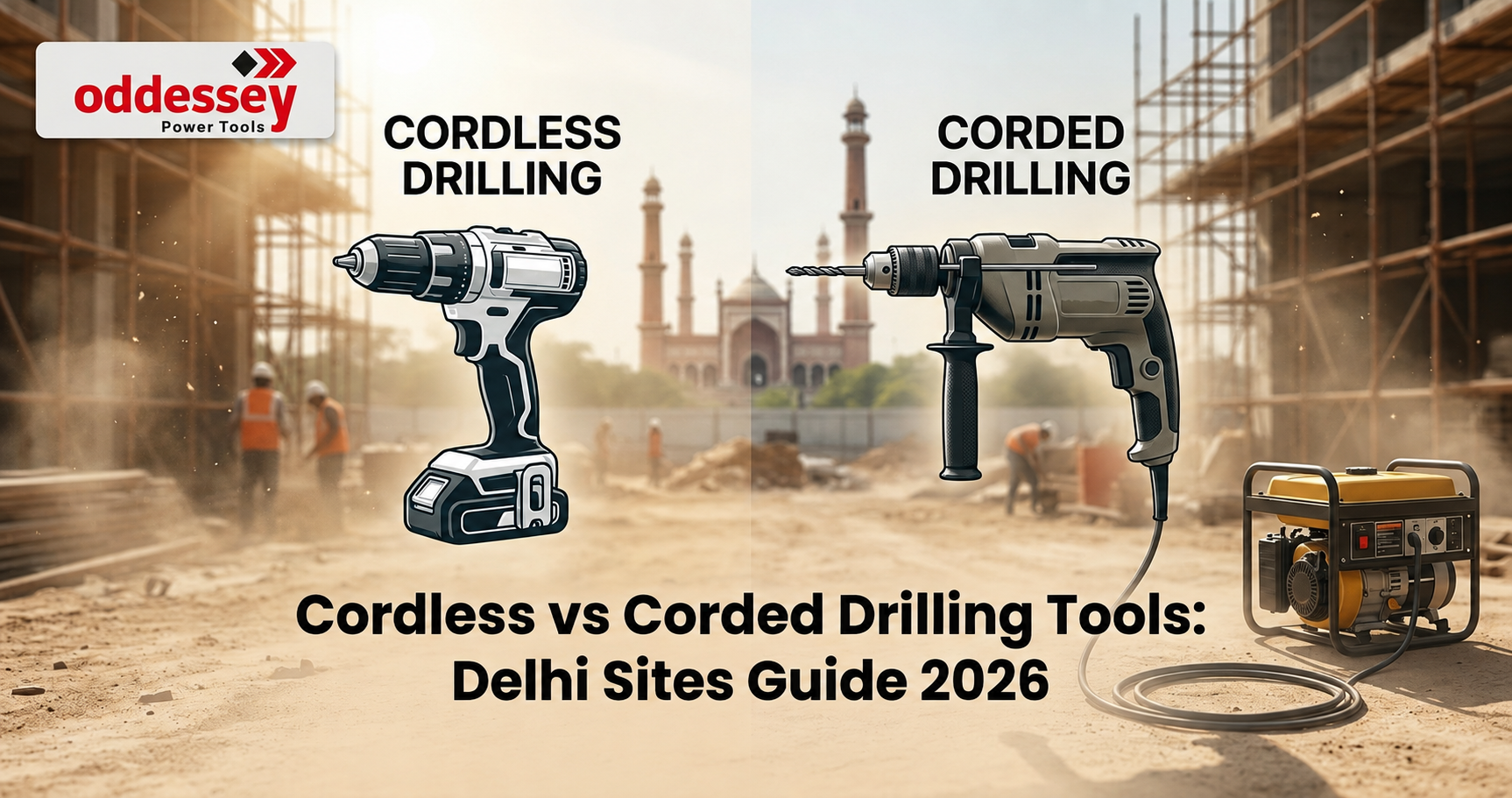
Cordless vs Corded Drilling Tools: Delhi Sites Guide 2026
Delhi’s construction sector hasn’t slowed down from builder-floor redevelopment in South Delhi to high-rise towers in Dwarka and Noida Extension, RRTS corridor work, and interior fit-outs across Rohini and Pitampura, drilling is one of the most repeated tasks on any site. Yet the question contractors, site engineers, and even independent electricians keep coming back to is surprisingly simple: should the crew be running corded machines or cordless ones?
The honest answer is that there isn’t a single correct choice. The right call depends on the wall material, the floor you’re working on, how reliable the site’s power connection is, and how many hours the tool needs to run without a break. This guide breaks down the real technical differences between cordless and corded drilling tools, how Delhi’s site conditions specifically affect that decision, and how to pick equipment that won’t let your crew down halfway through a pour. If your team is comparing high-speed drilling tools in Delhi for an upcoming project, this is the comparison to read before you place an order.
Understanding Drilling Tools: The Basics Before You Choose
Before comparing specs, it helps to be clear on what each tool actually is, because the terminology gets used loosely on Indian sites.
What is a Corded Drilling Tool?
A corded drill draws power directly from the mains through a cable, which means it never runs out of charge and delivers the same output from the first hole to the last. Corded drills are typically rated between 400W and 600W for general-purpose work, and 600W to 1000W+ for heavy-duty impact and hammer drilling into concrete, brick, and masonry. Because the motor is fed continuously by the grid rather than a battery, output stays stable even during long, repetitive drilling sessions which is exactly why corded machines remain the default on RCC structural work and core-cutting jobs.
What is a Cordless Drilling Tool?
A cordless drill runs on a rechargeable lithium-ion battery pack, usually rated between 12V and 20V for compact/DIY-grade tools and 36V to 37V (or dual-voltage 18V/36V systems) for professional, site-grade machines. The absence of a cable means the operator can move freely between floors, scaffolding, and tight corners without hunting for a socket or running an extension board across a wet site. Modern cordless drills increasingly use brushless motors, which has closed much of the performance gap that once separated cordless tools from corded ones.
Cordless vs Corded Drilling Tools: Key Differences at a Glance
| Parameter | Corded Drilling Tools | Cordless Drilling Tools |
| Power Source | Direct mains supply (220 – 240V) | Rechargeable lithium-ion battery (12V – 37V) |
| Typical Power Rating | 400W–1000W+ | Equivalent output via 18V–37V battery systems |
| Runtime | Unlimited while plugged in | Limited per charge; depends on Ah rating |
| Mobility | Restricted by cable length and socket access | Free movement across floors and scaffolding |
| Performance Consistency | Constant output, no voltage drop | Can experience voltage sag as battery drains |
| Weight | Generally lighter (no battery pack) | Heavier due to integrated battery |
| Best Suited For | Continuous heavy-duty drilling, RCC, core work | Multi-location work, finishing, tight access areas |
| Maintenance Needs | Motor brushes, cable checks | Battery health, charging cycles, contact cleaning |
| Site Dependency | Needs stable power point and extension cable | Independent of site power availability |
Power, Speed and Torque: What the Numbers Actually Mean
Spec sheets throw around RPM, BPM, and torque figures that mean little without context. Here’s what they translate to on an actual job.
RPM and BPM Explained
RPM (Revolutions Per Minute) measures rotational speed; higher RPM suits softer materials like wood, plasterboard, and thin metal sheeting where speed matters more than force. BPM (Blows Per Minute) applies to hammer and impact drills and measures how many times the bit strikes the surface per minute, which is what actually breaks through concrete, brick, and stone. A drill with high RPM but no hammer function will struggle on a masonry wall no matter how fast it spins; you need the impact mechanism for that.
Torque, Voltage Sag and Real-World Output
Torque is the rotational force the motor can sustain under load — it’s what determines whether the drill stalls or keeps boring through rebar-adjacent concrete. Corded tools maintain near-constant torque because mains voltage doesn’t fluctuate the way a discharging battery does. Cordless tools, by contrast, can experience what’s known as voltage sag: as the battery charge drops, output power drops with it, which is most noticeable in the final 20 – 30% of a charge cycle. Higher-capacity battery packs (5.0Ah and above) and brushless motors have narrowed this gap considerably, but it hasn’t disappeared.
| Tool Category | Typical Power | RPM Range | Impact Function | Best For |
| Light corded drill (400–600W) | 400W–600W | 0–2,600 RPM | Optional hammer mode | Wood, drywall, light masonry |
| Heavy-duty corded drill (700W+) | 700W – 1,000W+ | 0–3,100 RPM | SDS-Plus / hammer | Concrete, brick, core drilling |
| Compact cordless (12V–18V) | Battery-equivalent | Up to 1,650 RPM (no load) | Limited or none | Light fixing, electrical conduit, fit-outs |
| Professional cordless (20V–37V) | Battery-equivalent | Up to 2,000+ RPM | SDS / hammer (brushless) | Multi-floor work, structural fixing, mixed sites |
Why Delhi’s Construction Sites Change the Equation
Specs are only half the story. Delhi and NCR sites have a few recurring conditions that tilt the cordless-versus-corded decision in ways a generic buying guide won’t tell you.
Power Supply and Voltage Reliability
Older colonies, redevelopment plots in central and east Delhi, and sites still running on temporary construction connections can see voltage fluctuation, especially during peak summer load on the grid. A corded tool plugged into an unstable supply can run inconsistently or trip a board repeatedly, whereas a charged cordless tool simply doesn’t care what the site transformer is doing that afternoon. On large, well-powered sites with proper 3-phase connections common across Gurugram-border developments and organized DDA projects this isn’t as much of a concern.
Monsoon, Dust and Heat
Delhi’s monsoon months bring humidity and waterlogging risk around open cable runs and extension boards, which is a genuine safety concern for corded tools on ground-floor or basement work. Cordless tools remove that exposed-cable risk entirely. On the flip side, summer heat above 40°C can affect battery charge retention and charging speed, so cordless crews working through May and June need to manage battery rotation and shaded charging stations more carefully than they would in cooler months.
Site Access: High-Rises, Narrow Lanes and Builder Floors
Multi-storey builder-floor construction in areas like Rohini, Dwarka, and Janakpuri often means workers moving between floors without a continuous power line yet installed. Old Delhi’s narrow lanes and congested redevelopment sites can make running extension cables impractical or unsafe. In both situations, a cordless drill that doesn’t depend on a nearby socket is the more practical choice even if it means swapping batteries more frequently.
Pros and Cons: Corded vs Cordless on Indian Job Sites
| Advantages | Limitations | |
| Corded Drilling Tools | Unlimited runtime; consistent torque; generally lower upfront cost; simpler maintenance; ideal for continuous concrete/masonry work | Restricted by cable length and socket access; cable poses tripping/water hazard; less practical on upper floors without wiring |
| Cordless Drilling Tools | Full mobility across the site; no cable hazards; faster setup; ideal for multi-location and finishing work | Battery life limits continuous use; voltage sag near end of charge; batteries degrade over 3–5 years or 500–1,000 charge cycles; heavier due to battery pack |
Inside 2026 Drilling Technology: Brushless Motors and Battery Advances
Why Brushless Motors Matter
Brushless motors have become close to standard across professional-grade cordless tools in 2026, and for good reason. Without carbon brushes creating friction and heat, brushless motors run more efficiently, generate higher torque per watt of battery power, last considerably longer before needing service, and allow for smarter electronics like kickback protection and adjustable torque settings. The performance gap between a good brushless cordless drill and a mid-range corded one has narrowed enough that, for many finishing and fixing tasks, the choice now comes down to site logistics rather than raw power.
Battery Life and Long-Term Reliability
Lithium-ion battery packs typically hold up well for 3 to 5 years or 500–1,000 charge cycles before capacity noticeably declines. For a Delhi contractor running multiple shifts a day, that means budgeting for battery rotation and eventual replacement as a recurring cost of cordless ownership not a one-time purchase. Keeping batteries at moderate charge levels, avoiding full discharge cycles, and storing them away from direct heat (a real factor in Delhi summers) all extend usable life meaningfully.
Matching the Right Tool to Your Project
| Project Type | Recommended Tool | Why |
| RCC structural drilling, column/slab work | Heavy-duty corded hammer drill | Continuous power needed for long, high-torque sessions |
| Multi-storey builder floor / vertical movement | Professional cordless drill (20V+) | No dependency on floor-by-floor wiring |
| Interior fit-out, false ceiling, electrical conduit | Compact cordless drill | Lightweight, fast, ideal for repeated small holes |
| Demolition-adjacent masonry, brick walls | Corded or high-voltage cordless SDS drill | Needs strong impact/BPM output |
| Narrow-lane or congested redevelopment sites | Cordless drill | No safe space for cable runs |
| Outdoor infrastructure, road or boundary work | Heavy-duty corded or 36V+ cordless | Long, sustained drilling into hard surfaces |
Maintenance Tips to Extend Tool Life in Delhi’s Climate
Dust is the single biggest threat to any drilling tool on an Indian construction site, corded or cordless. Cleaning air vents and motor housings regularly prevents overheating, especially during peak summer use. For corded tools, inspecting cables and plugs for wear before every shift frayed insulation combined with monsoon dampness is a real hazard, not a theoretical one. For cordless tools, keep battery contacts clean and dry, avoid leaving packs in direct sun on-site, and store them at room temperature rather than in a metal site office that heats up through the afternoon. Both tool types benefit from periodic chuck lubrication and prompt replacement of worn drill bits, which reduces strain on the motor far more than people expect.
Site Safety: Non-Negotiables for Both Tool Types
Whichever tool your crew uses, a few safety basics shouldn’t be optional. Always use an RCD (residual current device) or ELCB-protected supply point for corded tools, particularly during monsoon months when ground moisture is unavoidable. Check that any corded equipment carries proper BIS/ISI certification for the Indian electrical standard. For both tool types, insist on safety goggles and dust masks during concrete and masonry drilling, and make sure operators are trained on correct grip and stance to avoid kickback injuries, a more common issue with high-torque hammer drills than most new operators expect.
Where to Source Reliable High-Speed Drilling Tools in Delhi
Tool performance on paper means little if the supplier behind it isn’t dependable. Oddessey Power Tools, based in Pitampura, New Delhi, has built its reputation around exactly the kind of decision this guide covers supplying both high-speed corded drilling tools and professional-grade cordless machines suited to the realities of NCR construction sites, from RCC structural work to multi-storey fit-outs.
What sets a local, Delhi-based supplier apart is the ability to recommend equipment based on your actual site conditions rather than a generic catalogue listing whether that means a heavy-duty corded hammer drill for a slab-heavy RCC project or a 20V+ cordless system for a crew moving across floors with no fixed power point yet. Oddessey Power Tools’ range is built around durability for Indian site conditions: dust resistance, stable performance in fluctuating voltage environments, and after-sales support that doesn’t leave contractors stranded mid-project. For teams comparing high-speed drilling tools in Delhi, working with a supplier who understands these local variables, not just the spec sheet, makes the eventual choice considerably easier.
Common Mistakes Contractors Make When Choosing Between the Two
A few recurring mistakes show up across Delhi sites regardless of project size. The first is buying based purely on wattage or voltage numbers without checking whether the tool has the right impact mechanism; a high-wattage drill without hammer/SDS function still won’t touch reinforced concrete. The second is standardizing an entire crew on cordless tools without budgeting for spare batteries, which leaves teams waiting on charge cycles during peak working hours. The third is the opposite mistake: running corded tools through unprotected extension boards during monsoon season, which is both a safety risk and a common cause of tripped circuits mid-task. Finally, many site supervisors overlook chuck size and bit compatibility entirely, only to discover mid-project that their drill can’t accept the masonry or SDS bits the job actually requires. Working with a supplier who asks about the project before recommending a tool rather than pushing whatever’s in stock avoids most of these issues before they cost a day of labour.
FAQ
1.Is a cordless drill powerful enough for concrete work on a Delhi construction site?
Yes, provided you choose a professional-grade cordless drill (20V and above) with hammer/SDS function and a brushless motor. For continuous, high-volume concrete drilling across a full shift, a heavy-duty corded drill still offers more consistent output.
2.Why do corded drills still matter in 2026 if cordless technology has improved so much?
Corded drills offer unlimited runtime and constant torque without the cost or maintenance of battery packs. For production environments running long, repetitive drilling sessions, that consistency still outperforms even high-end cordless systems.
3.How does Delhi’s power supply affect the choice between corded and cordless tools?
Sites with stable 3-phase connections suit corded tools well. Sites with temporary connections, frequent voltage fluctuation, or no wiring on upper floors benefit more from cordless tools that aren’t dependent on the site’s electrical supply.
4.How long do cordless drill batteries typically last on a construction site?
Most lithium-ion battery packs hold up for 3 to 5 years or 500 – 1,000 charge cycles under regular professional use, after which capacity and runtime noticeably decline.
5.Can one drill handle both wood and concrete drilling?
A drill with a hammer/impact function and adjustable speed control can handle both, provided you switch to the correct mode and bit type masonry bits for concrete and brick, standard bits for wood and metal.
6.What safety certification should I check before buying a corded drilling tool in India?
Look for BIS/ISI certification, which confirms the tool meets Indian electrical safety standards particularly important for tools that will be used with extension cables on sites exposed to monsoon moisture.
7. Is it worth keeping both corded and cordless drills on the same site?
For most mid-to-large Delhi projects, yes. A heavy-duty corded drill handles sustained structural work, while a cordless drill covers mobility-dependent tasks like upper-floor fixing or fit-out drilling. Relying on only one type usually means compromising on either power or flexibility somewhere in the project.
8.Does chuck size matter when choosing a drilling tool?
Yes – a 10mm or 13mm chuck determines the maximum bit diameter the drill can hold. Heavier masonry and concrete work generally needs a 13mm chuck or SDS-Plus fitting, while lighter fixing and fit-out tasks manage well with a 10mm chuck.
Summary
Corded drilling tools deliver unlimited runtime and consistent torque, making them the stronger choice for continuous, heavy-duty concrete and RCC work. Cordless drilling tools, especially modern brushless models running on 20V – 37V batteries, offer the mobility that multi-storey builder floors, narrow-lane redevelopment sites, and fluctuating-power locations across Delhi genuinely need. RPM and torque determine how a tool performs on different materials, while BPM and impact function determine whether it can break through masonry at all. Battery life, voltage sag, and Delhi’s climate both monsoon dampness and summer heat all factor into which tool type holds up best on a given site. Matching tool type to project type, rather than defaulting to one or the other, is what actually separates an efficient crew from one losing hours to the wrong equipment.
Conclusion
There’s no universal winner between cordless and corded drilling tools, only the right tool for the site in front of you. A heavy-duty corded hammer drill remains hard to beat for sustained RCC and masonry work where power access isn’t a constraint. A professional cordless drill earns its place the moment your crew needs to move across floors, work in tight lanes, or operate on a site where the power connection isn’t fully reliable yet. The smartest approach for most Delhi contractors is keeping both options available and matching them to the job rather than the habit. For sourcing dependable, site-ready high-speed drilling tools in Delhi corded or cordless Oddessey Power Tools remains a practical starting point for contractors who need equipment built for how Delhi sites actually operate, not just how a spec sheet reads.
Follow us on – Facebook , Instagram
You may also read: – Affordable Wood Cutting Blades for Bulk Buyers in Delhi